
Sea Truffles
How could anyone not love one of the most appreciated shellfish for its unique and exclusive flavor? We’re talking about sea truffles, bivalve mollusks scientifically known as “Venus Verrucosa”.
Reaching a maximum length of 7 cm, they’re ideal for any type of diet thanks to their high content of vitamins and minerals, essential for the proper functioning of our body.

Morphological characteristics of sea truffles

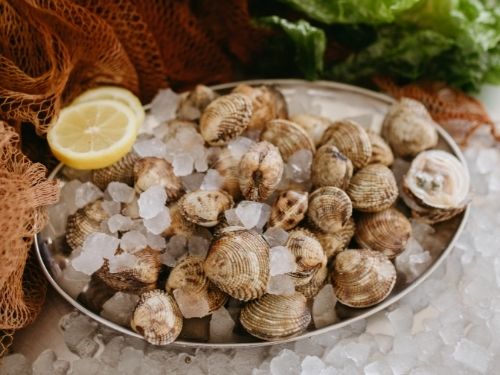
Sea truffles are characterized by a very strong shell, inequilateral and equivalve, with an oval shape. The anterior side is noticeably smaller than the posterior one. On the outer surface of both valves, there are very visible concentric striations. The pallial sinus is small and pointed.
Compared to clams, the shell is more rounded, with a rougher and grainier texture, featuring ridges and lamellae. Internally, however, there are many similarities: the foot is large and tongue-shaped, and the siphons are short and dark, and not equal in length. The external coloration of sea truffles tends to grey or yellowish-brown, while the inside is glossy white.
Nutritional values of sea truffles
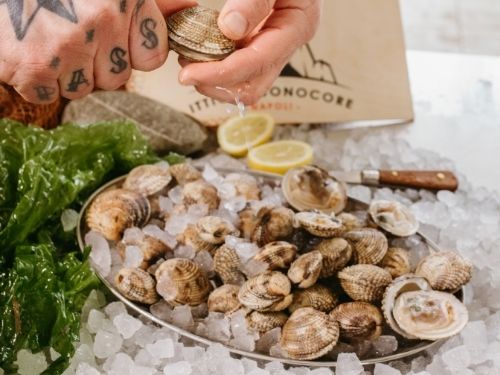
Besides being a tasty and flavorful ingredient, sea truffles are rich in protein, vitamins, and minerals, and low in calories (only about 85 kcal per 100 grams).
Vitamin B, A and D, calcium, sodium, phosphorus, iron, calcium, magnesium, potassium, zinc, selenium: all in a single shellfish! A lean food that’s also rich in protein.
It’s also important to note that, due to their significant sodium content, they should be consumed in moderation by individuals with high blood pressure. As previously mentioned, they are perfect for low-calorie diets due to their low fat content.
Biology and ecology of sea truffles

Sea truffles are aquatic creatures belonging to the Veneridae family, of the Venus verrucosa species. Their origins are from:
- The Eastern Atlantic, from the British Isles to Angola and South Africa;
- the Mediterranean Sea;
- the Indian Ocean.
They thrive in sandy and muddy seabeds, typical of the Adriatic Sea. While in the Mediterranean they are usually found at depths of around 20 meters, in the ocean they can go as deep as 100 meters. They mainly feed on phytoplankton and multicellular algae, filtered through the siphons. They often hide to escape from predators, including starfish.
It’s best to harvest them by divers’ hands, but another way is to use dredges mounted on fishing boats. Their ideal breeding period falls between late spring and early summer, although they can be found throughout the year.
Sea truffles: the undisputed stars of countless recipes
Who hasn’t tried a raw sea truffle at least once? In recent years, eating them raw has become a common practice, making it even more important to verify the origin of this mollusk.
That’s why Ittica Buonocore guarantees the absolute freshness and quality of all its shellfish, which, if necessary, undergo a rigorous purification process before being sold.
A true delicacy, loved by all for its versatility in countless dishes. How could we not mention spaghetti with sea truffles, or the ever-popular gratinated truffles? All it takes is a pinch of creativity and originality to bring a unique and exclusive dish to life.
Other Products




Where we are
83 Lufrano Street
Volla, NA 80040
our schedules
H24 distribution
Office 9 – 18


