
Venus Clams
What’s not to love about one of the most prized shellfish on our tables? We’re talking about venus clams, marine mollusks belonging to the Veneridae family. A food that’s as traditional as it is contemporary, venus clams are the star of many mouth-watering dishes! With an excellent nutritional profile and tender, flavorful meat, let’s explore what makes these clams so special!

Morphological characteristics of Venus clams
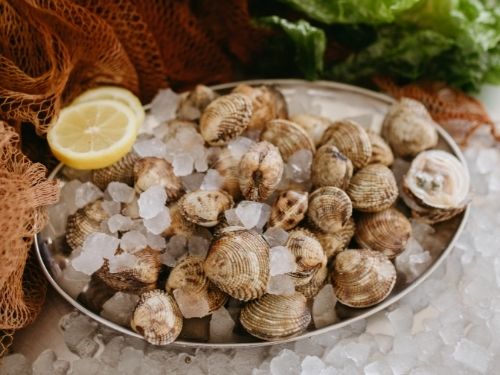
 Venus clams feature a solid, glossy shell, equivalve but inequilateral, with an ovoid shape. Reaching up to 11 cm in length, their anterior side is shorter than the posterior, and the umbo is curved forward. On the outer surface of the two valves (very smooth) there are numerous fine concentric growth lines.
The pallial sinus is large, with a pointed front end that does not curve upwards. The soft part of the clam includes the foot, which the mollusk uses to move and bury itself in the sand to avoid predators. The hinge structure shows distinct lateral teeth:
- One on the left valve;
- Two separated by a deep pit, on the right valve.
The opening of the valves allows the clam to filter water for feeding. Although they resemble clams in shape, venus clams are larger, reaching up to 11 cm in diameter and weighing up to 100 grams.
The internal coloration is glossy white. The external coloration is light brown with darker radial bands extending from the hinge to the shell margin.
Habitat and distribution of Venus clams

Venus clams are primarily found in:
- The Mediterranean Sea;
- The eastern Atlantic, from the British Isles to Morocco.
They thrive on sandy and muddy seabeds, typically at shallow depths of 15–20 meters. They prefer areas close to the shoreline, where they settle into their natural habitat. These mollusks often cluster around elevations on the seafloor (known as sandbanks), making the Adriatic Sea an ideal environment for them.
Venus clams are mainly harvested using hydraulic dredges with turbo-blowers. These tools sift through the sand, locating and collecting the mollusks. Unlike other clams, manual harvesting is not permitted, as the areas where Venus clams live are difficult or impossible to access by hand.
Nutritional value and health benefits of Venus clams
 Every 100 grams of Venus clams provides approximately 52 kcal. According to Humanitas, their nutritional values are as follows:
- 8.5 g of protein
- 1 g of carbohydrates
- 0.47 g of lipids
- 20.5 mg of magnesium
- 2.0 mg of iron
- 1.25 mg zinc
As you can see, Venus clams are a low-calorie food suitable for a variety of dietary plans and often recommended in many nutritional regimens, thanks to their high protein content and very low fat levels. Due to their sodium content it’s best to limit consumption for individuals with hypertension, although draining the internal water from the mollusk can help reduce the sodium level considerably.
Venus clams: how to clean and use them in cooking
 Cleaning Venus clams is a crucial step before consumption. Like all seafood, they should be alive at the time of purchase and have tightly closed shells (a clear sign of freshness and quality).
As it is for oysters, you have to be careful when opening Venus clams. A small mistake can lead to the loss of their valuable internal juices and nutrients. If you buy Venus clams that have already undergone a proper purification process, such as those from Ittica Buonocore, here are the steps to follow:
- Use the right shellfish knife;
- Hold the mollusk firmly and insert the blade into the gap between the two valves;
- Do not discard the internal water, as you can use it in your recipe;
- Then detach the meat from the shell.
At this point you can enjoy Venus clams raw. If that suits your taste, you can add a touch of salt, pepper and lemon juice.
Alternatively, Venus clams are incredibly versatile and can be used in a variety of cooked dishes, such as:
- A seafood salad;
- An italian risotto;
- Sautée;
- Fresh pasta with Venus clams.
- …and many more.
Other Products




Where we are
83 Lufrano Street
Volla, NA 80040
our schedules
H24 distribution
Office 9 – 18


