
Tellins
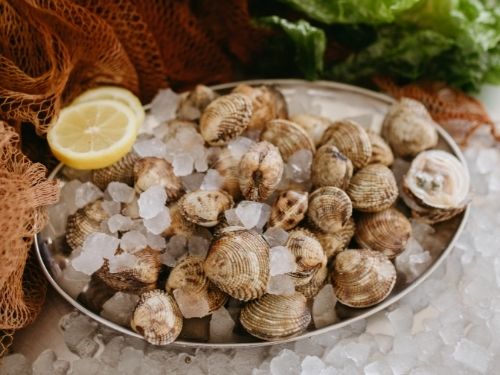
These exceptional bivalve mollusks, commonly known as tellins, belong to the Tellinidae family. Their scientific name is Donax trunculus, referring to those fantastic little smooth, rounded shells.
Loved for their delicious meat, delicate flavor and fresh, enticing aroma, they pair wonderfully with a variety of ingredients, making them perfect for countless recipes and dishes. Let’s explore all their features together.

Tellins distinctive morphological features and distribution
 The shell of the tellin is slightly inequivalve, as the dorsal margin of the left valve slightly extends beyond that of the right. It is also inequilateral and roughly subtriangular in shape. The anterior side is rounded and longer than the posterior side, which appears cut off and oblique.
On the outer surface of the valves, there are longitudinal growth lines, more visible on the front, and fine radial lines that are slightly darker in color than the rest of the shell.
Inside the shell, you’ll find a beautiful white mother-of-pearl with hues of brown and violet. The outer edge is finely serrated, featuring a whitish-yellow, olive, violet, or brownish coloration especially in the darker areas (where the radial lines are more visible).
They can grow up to 5 cm, though the average size is about 2–3 cm. To move around, they use their pointed foot and siphon to filter food. They are remarkable, fast diggers, although they don’t travel great distances.
They have separate sexes and reproduce mainly between spring and summer.
Where do tellins come from?
Tellins are primarily found in:
1. The Mediterranean Sea, where they can be found between 0 and 2 meters in depth;
2. The Eastern Atlantic Ocean, from the British Isles to Senegal, found between 0 and 6 meters deep;
3. The Red Sea.
They are classified as a “characteristic and exclusive species of fine sandy high shore environments.”
Habitat and fishing of tellins (Donax trunculus)
Do you know what’s these mollusks favorite habitat? They love living in large colonies near dense seagrass beds of Posidonia. For those unfamiliar, Posidonia is a widespread seagrass found in the oceans. Tellins prefer sandy seabeds and rarely live deeper than 10 meters, with an average depth of around 3–4 meters.
As for fishing methods, they are quite similar to those used for clams. Tellins are harvested using dredges, hand rakes, or water jet turbines. .
Nutritional properties of Donax Clams: let’s discover them together
 Delicious flavor, distinctive taste and tender, flavorful meat. But not just that: they are also rich in Vitamin A, phosphorus, high-quality proteins, Omega-3 fatty acids and potassium. Ideal for low-calorie diets, as 100 grams of edible portion only provide 72 kcal.
However, some caution is advised in the following cases:
- Hypertension, due to their natural sodium content, consumption should be moderate and carefully managed.
- Hypercholesterolemia: they can be eaten in small portions, no more than once a week (always follow the advice of your trusted healthcare provider).
Three reasons why you should choose Ittica Buonocore’s tellins:
First one is that we guarantee maximum freshness, traceability top quality.
At Ittica Buonocore, we ensure the highest standards in product selection and handling.
Second one is that tellins are the star of many traditional dishes, from seafood risottos to spaghetti with clams and classic seafood sautés.
And last: once you’ve tried them, you’ll keep coming back for more!
Other Products




Where we are
83 Lufrano Street
Volla, NA 80040
our schedules
H24 distribution
Office 9 – 18


