
VARIEGATED SCALLOP
Did you know that in Italy we call this species “piè d’asino”, “donkey’s feet”? The choice of this name comes from their striking resemblance to the legs of the friendly equine! These bivalve mollusks are also known as amandes or sea almonds and they’re mostly found in the waters of the Eastern Atlantic. Appreciated for their flavorful, meaty flesh, they’re easily distinguished from other families by their consistently round shape. Let’s take a closer look at their features.

Organoleptic characteristics of the Variegated Scallop

The shell of the Variegated Scallop is round, symmetrical and sturdy, with a central umbo from which numerous fan-like striations radiate. The mollusk has a hatchet-shaped foot, which becomes visible when it moves along the seabed. Normally, it remains sealed within its two valves. Some notable physical traits include:
- Two equal-sized muscle scars (from the adductor muscles);
- A curved hinge featuring small teeth;
- A finely scalloped inner margin.
There’s no pallial sinus. In terms of color, the shell is a reddish-brown with white or beige undertones. They can grow up to 7–8 cm in size.
Habitat, Distribution and Curiosities
Variegated Scallop thrive on muddy, sandy, or pebbly sea bottoms, where they are harvested using various techniques (such as rakes, dredges and trawl nets). Much like clams, they tend to form dense colonies along the coasts of the Atlantic Ocean and Mediterranean Sea. One remarkable trait is their ability to adapt to low-oxygen environments. Depending on the region, they go by several names:
- Palorda or cozze ‘e schiave in Campania;
- Nuce or cozze scarpare in Puglia;
- Cuppa liscia in Sicily.
In French and German, they are referred to as “amande de mer”.
Main Species of Variegated Scallop
It isn’t always easy to distinguish between the various species of Variegated Scallop. Over the years, there have been several debates about how to tell apart, for instance, the Bimaculata from the Insubrica. Today, classification standards have been established based on factors like shell shape, size, length ratios, and the position and structure of the hinge. That’s why we have:
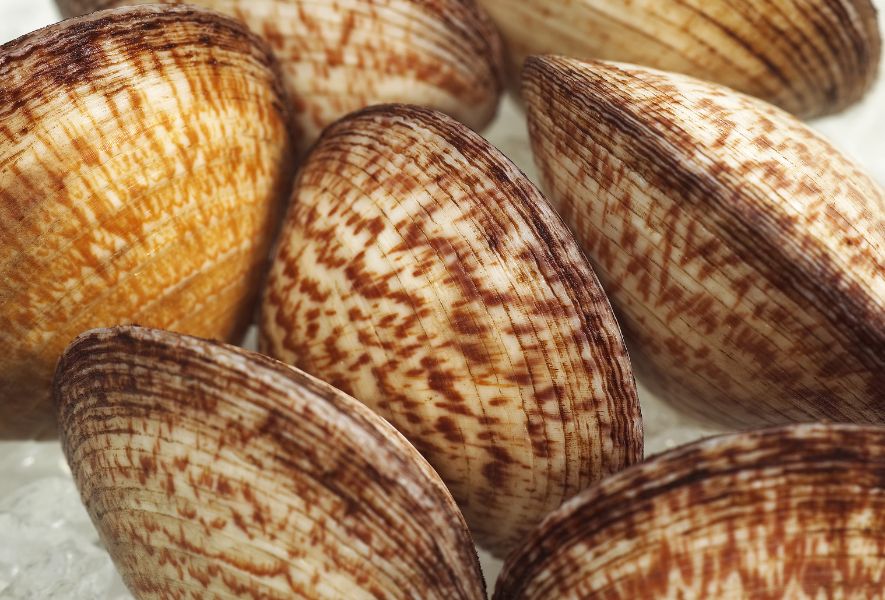
GLYCYMERIS BIMACULATA
This species is easily distinguished by the fact that it has maximum width at the hinge. The latter is of considerable size.
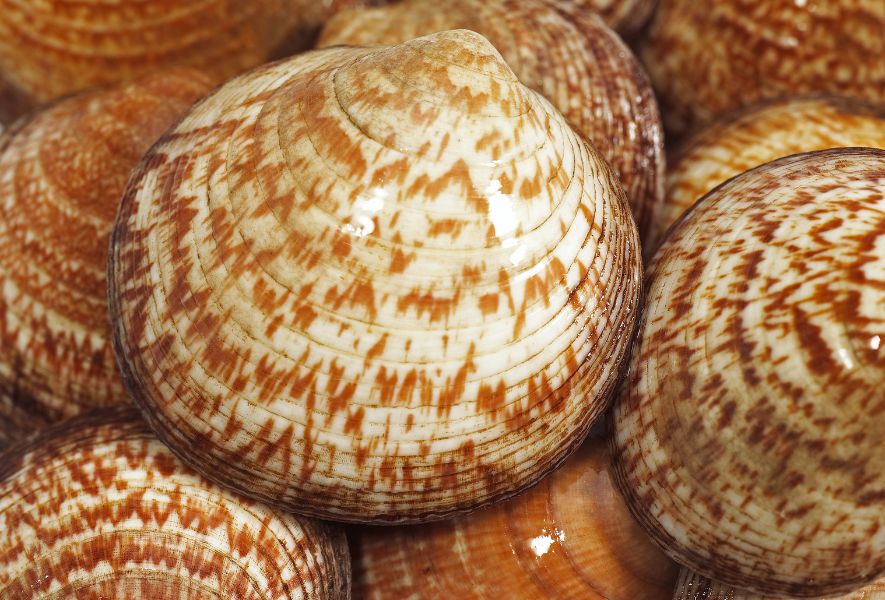
GLYCYMERIS PILOSA
It is characterized by a swollen and robust shape, angular in places. The hinge is continuous as is the Bimaculata with small teeth.

GLYCYMERIS GLYCYMERIS
It has an almost regular, round shape. It is characterized by a large ligamentary area with a hinge that is not continuous but strongly divided.

GLYCYMERIS INSUBRICA
Here the hinge is continuous with small sayings. The ligamentary area functions as a separator between umbo and hinge. The shape is blunt and quadrangular
Other Products





Where we are
83 Lufrano Street
Volla, NA 80040
our schedules
H24 distribution
Office 9 – 18


