
GLYCYMERIS GLYCYMERIS
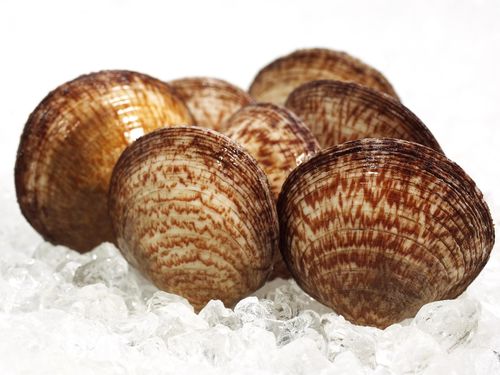
With a maximum length of 8.5 cm, Glycymeris glycymeris has a robust, equivalve shell that is less globose than that of other species. It is almost entirely equilateral, although it should be noted that the umbones are tilted backward, and the postero-ventral margin appears flattened.
Some specimens have a diagonally elongated shell, with an axis running from the umbo to the postero-ventral edge.
This species is also characterized by fine growth striae and radial striae, the latter being discontinuous, unlike the former.
Additional distinguishing features of Glycymeris glycymeris include:
- Muscle scars located at the ends of a thick radial band;
- The anterior muscle scar is sub-triangular in shape;
- The posterior muscle scar is elongated and quadrangular;
- The periostracum is dark brown and almost completely covers the shell surface;
- A reddish-brown coloration over a white to beige background;
- The shell margin is crenulated;
- The ligament is duplivincular;
- A strong hinge with many teeth. To be precise: 3–4 anterior lateral teeth and 5–6 posterior teeth.
What sets this species apart from Glycymeris bimaculata is the presence of the opisthogyrate umbo (posteriorly tilted).
This species is widely distributed throughout the Mediterranean Sea, the Eastern Atlantic (especially along the coasts of Norway and the Iberian Peninsula) and France (where the species is especially common).
Other Products




Where we are
83 Lufrano Street
Volla, NA 80040
our schedules
H24 distribution
Office 9 – 18


