
Mussels
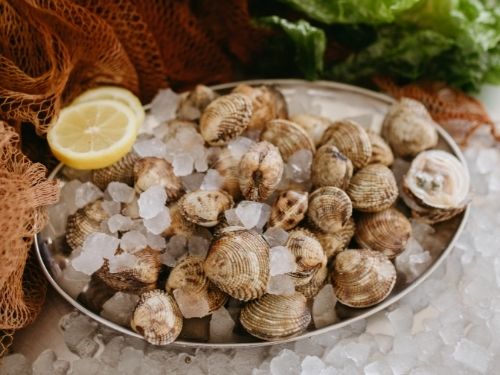
How could anyone not love mussels? One of the sea’s finest treasures, a true culinary wonder to be savored and celebrated for their unique, unmistakable flavor. Mussels are the stars of countless recipes, whether they’re prepared as appetizers, pasta dishes, or main courses.
These beloved bivalve mollusks are easily recognized by their teardrop-shaped shells, with two symmetrical parts, called valves, connected by a hinge. Mussels are not only delicious but also packed with numerous health benefits, making them an ideal choice for any healthy diet. Let’s take a closer look!

The health benefits of mussels
 A true natural remedy, mussels are a nutrient-rich superfood that is both flavorful and light. They are rich in vitamins, minerals, proteins and antioxidants. That’s why they can:
- Fight free radicals, helping prevent cellular aging and degeneration;
- Boost the immune system, offering natural protection against seasonal illness;
- Reduce inflammation, thanks to their high glucosamine content, useful for arthritis and joint pain;
- Help prevent water retention, due to their potassium content;
- Support healthy blood pressure, making them a great choice for individuals with hypertension.
They are also a great source of B vitamins, which provide energy and strengthen both the nervous and muscular systems (phosphorus helps improve mood, memory and focus). That’s why they’re perfect for active lifestyles and those who exercise regularly.
Also, thanks to their iron content, mussels are a key food for people with anemia.
A smart choice for a balanced diet
Do mussels make you gain weight? Absolutely not! In fact, they stimulate metabolism, regulating fat absorption. Optimal for liver functions too, thanks to vitamin B.
100 grams of mussels only contain 84 kcal, making them an excellent option for low-calorie diets.
Three curious facts about mussels
 The history of mussels is surprisingly rich. They’ve been considered a delicacy since Paleolithic times. And they were widely consumed across Europe, Patagonia and South America. It was the French who claimed the primacy of the first breeding in the 8th century.
In Italy, the earliest records date back to 1732, referring to mussel farming in the Gulf of Trieste. In truth, however, it was less of an actual farm and more of a natural colonization of the famous wooden poles that were submerged into the seabed. Their large-scale spread followed World War I, when mussels became a vital source of income for coastal fishermen.
The second fun fact about mussels concerns their sex. How can you tell the difference? Simple. It’s the color of the flesh that reveals whether the mussel is male or female. If the color is bright orange, it’s female; if it has yellowish tones, it’s male. You know which ones are more popular? The females, for their sweeter and more delicate flavor.
The third fun fact involves a study on mussels, specifically focusing on their byssus. For those unfamiliar with it, the byssus is a bundle of fibers known for its remarkable resistance to water and weathering. That’s why it would be a promising material for surgical use, especially for sutures.

Hairy mussel
Modiolus Barbatus

ARCTIC MUSSEL
Modiolus Modiolus

CHOLGA MUSSEL
Aulocomya ater

BLUE MUSSEL
mytilus edulis

BROWN MUSSEL
perna viridis

BROWN MUSSEL
perna picta

MEDITERRANEAN MUSSEL
Mytilus Galloprovincialis

GIANT MUSSEL
Chloromytilus chorus

CHILEAN MUSSEL
Mytilus Chilensis

GREEN-LIPPED MUSSEL
Perna Canaliculus
Other Products




Where we are
83 Lufrano Street
Volla, NA 80040
our schedules
H24 distribution
Office 9 – 18


