
Hairy mussel

The hairy mussel, also known as Thricomya, the hairy mussel is one of the most prized bivalve mollusks, starring in countless culinary dishes, both traditional and contemporary gourmet cuisine.
Today we’ll explore the morphological, biological, and nutritional features of this unique shellfish. Let’s dive in!
Morphological and biological characteristics of the Hairy Mussel
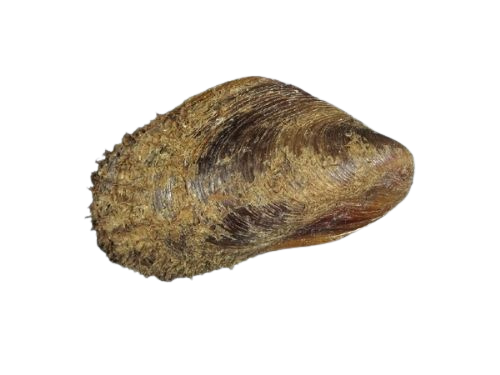
 Modiolus barbatus is a bivalve mollusk characterized by its oval, elongated and triangular shell, which is noticeably convex in the front. One striking feature of its shell is its perfect symmetry—the upper and lower parts mirror each other exactly.
The two valves (the “faces” of the shell) are joined by a hinge and are distinguished by a layer of bristly hair-like filaments (that’s where its name, hairy mussel, comes from), which vary in length and density. The outer surface of the shell also shows concentric growth rings, indicating the mollusk’s age and development over time.
The umbo is not very prominent and is located at the front of the shell. Inside we have the mantle that covers, contains and shields all internal organs, especially the reproductive ones. How to tell females from males? Females have a bright orange color, while males are creamy white.
They grow to a maximum length of 6 cm, though the average size ranges from 4 to 5 cm.
Differences between hairy mussels and other species
What makes them stand out from other types of mussels?
- Their outer shell is brownish-yellow rather than black;
- They’re covered with distinctive bristly filaments;
- They have a saltier and more intense flavor (which we’ll explore more in a moment);
- Their shape is elongated and somewhat irregular, with a rounded rear end opposite the umbo.
What do hairy mussels eat?
They feed on plankton and organic particles, which they collect and filter through their gills. For this reason, it is essential to purchase them from certified purification centers, which guarantee the product is thoroughly cleansed, purified and ready to use.
In regions like Puglia it’s common to eat them raw, but we strongly recommend a proper purification process beforehand to eliminate any potential pathogens.
Biology and reproduction of hairy mussels
One of the main factors influencing the reproduction of hairy mussels is the latitude where they live. Once the eggs are released, they are carried by the current for an average of 72 hours. After this period, the larvae settle on the first solid surface they encounter, such as a rock or stone. How do they attach themselves? Through DOPA (L-3,4-dihydroxyphenylalanine), a fiber that allows the mussel to permanently attach to the supporting surface (in fact, it can take years to detach them and destroy the byssus, meaning the filament that holds them in place).
Distribution, fishing and farming of hairy mussels
 The main diffusion of hairy mussels is in:
- The Mediterranean Sea, where the species is very common;
- The Eastern Atlantic, from the British Isles to Morocco, including the Azores and Cape Verde islands.
As we said before, they are especially abundant in the Ionian and Adriatic Seas. In Puglia they are considered a true delicacy.
As for farming, hairy mussels are relatively easy to cultivate: fishermen suspend ropes into the sea during the spawning season, and wait for the larvae to attach. With patience, care and experience, with maximum respect of regulations (and always respecting the weight limits), and with the best techniques, they can be grown successfully!
Organoleptic qualities and nutritional values of hairy mussels
Hairy mussel meat can be described in three words: flavorful, savory and firm. They are the star ingredient in countless dishes, be it appetizers, pasta and main courses. In short, the true stars of the kitchen thanks to their incredible versatility.
Compared to Mytilus galloprovincialis they have a stronger, more briny taste, a result of the saline waters they inhabit.
Nutritionally, they are almost identical: hairy mussels are characterized by low fat content and high protein levels. They are therefore rich in proteins and minerals (especially sodium, phosphorus, and potassium) while remaining low in calories. A 100-gram serving contains just 84 kcal.




Where we are
83 Lufrano Street
Volla, NA 80040
our schedules
H24 distribution
Office 9 – 18


