
Clams
Clams are a staple ingredient in Italian cuisine and a star of many Mediterranean diet dishes.
They are bivalve mollusks belonging to the Veneridae family, and are characterized by two sturdy shells, often oval or triangular in shape. Their coloration can vary from white to brown and from grey to tan.
Small to medium in size, clams are true filter feeders. What does that mean? That they draw nutrients from marine currents and water, feeding mainly on phytoplankton and microorganisms.
It’s important to note that if clams do not have access to an adequate and consistent food supply, they are unable to reproduce and will not lay eggs!
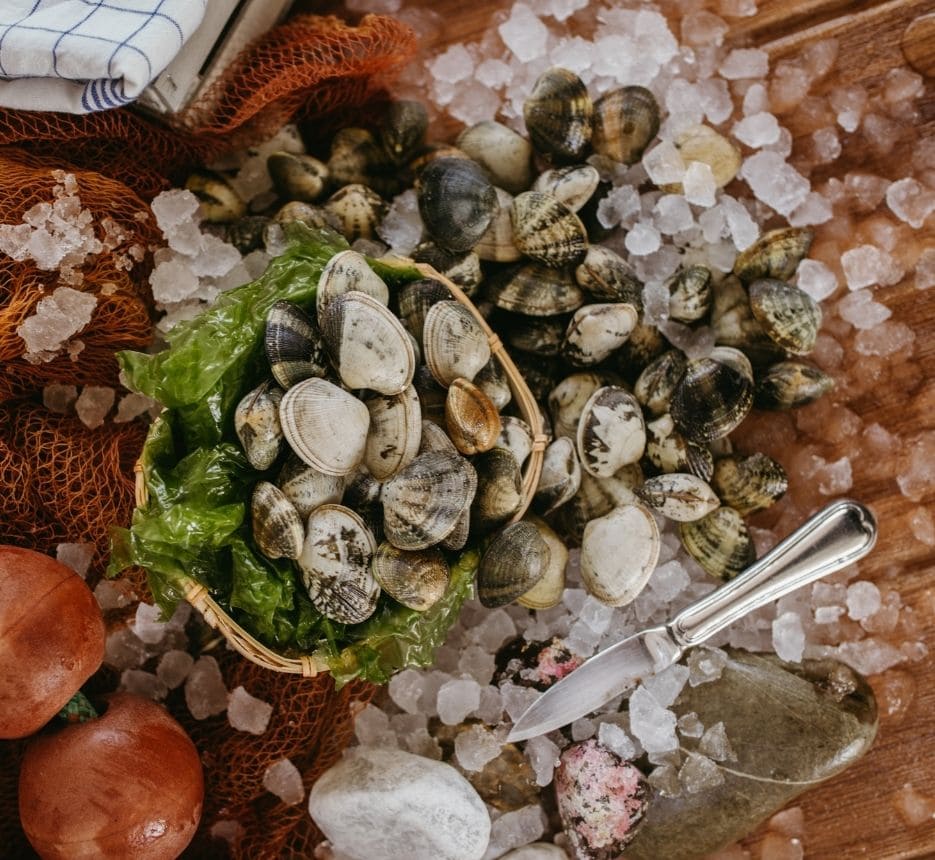
Nutritional value and health benefits of clams: let’s take a look
 Farmed and harvested along most national and international coastlines, clams are the pride of countless recipes featured by top chefs.
The nutritional profile for 100 grams of clams (72 kcal) are:
- 82.5 g of water
- 10.2 g of protein
- 67 mg cholesterol
- 2.5 g of fats
- 2.2 g of available carbohydrates
- 2.2 g of soluble sugars
- 1,202 mg sodium
- 628 mg potassium
- 92 mg of calcium
- 28 mg of iron
- 18 mg magnesium
- 0.1 mg of vitamin B6
- 16 mg of vitamin A (retinol equivalent)
- trace amounts of vitamin C
As the data shows, 57% of the energy comes from protein, 31% from fat, and the remaining 12% from carbohydrates.
Clams are a great source of potassium and essential minerals that help regulate blood pressure and support heart health. They are a true blessing for muscle and nervous system function, thanks to their high vitamin content, including B6, A, D, and K. Their low calorie count makes them an ideal choice in many dietary plans.
The main species of clams: let’s discover them together
 There are many clam species in the world. Here, we’ll focus on the most commonly known and commercially appreciated varieties. For each one, you’ll find an in-depth look at its biological and morphological characteristics, origin, and farming or harvesting methods.

Venerupis Decussata
It is the one that holds the title of “Vongola Verace,” as a native species of the Mediterranean Sea. The distinguishing feature of this species is the presence of two separate siphons. Due to intense fishing activity, it is often considered an endangered species.

Ruditapes philippinarum
Ruditapes Philippinarum is native to the Eastern Seas. It arrived in European waters in 1972, spreading mainly in Italy, France and Ireland. It is considered globally to be one of the most sought-after shellfish species, so much so that it, too, has been given the appellation “True Clam.”

Mercenary Mercenary
The history of the American clam has very ancient origins: it dates back to 1620 and was used in traditional seafood cuisine as the star of multiple dishes. Its secret? Keeping the Quahog pearl inside.

Venerupis Pullastra
With firm and delicious meat, the Venerupis Pullastrae clam, is called Longon. Harvesting in the Galician region is still done in the traditional way today: fishermen walk through the affected areas, using hand shovels or the ancient rakes, to remove seaweed from the beds.

Icelandic Arctic Clam
The Arctica Islandica clam belongs to the family Arcticidae. Known to all for the extraordinary case of Ming, the oldest animal ever discovered, living for more than 500 years.

MERETRIX LYRATA
Vongola del pacifico
Meretrix Lyrata, commonly known as the Pacific Clam, is characterized by its white shell, therefore also referred to as the White Clam. Distribution occurs in the western Pacific.
Other Products




Where we are
83 Lufrano Street
Volla, NA 80040
our schedules
H24 distribution
Office 9 – 18


