
Venerupis Decussata

Venerupis Decussata, or Ruditapes Decussatus, is a bivalve mollusk belonging to the Veneridae family. It holds the title of “True Clam” (Vongola Verace in Italy) as it is an indigenous species of the Mediterranean Sea, although this designation was originally exclusive to Ruditapes decussata, it has since been extended to include Ruditapes philippinarum as well.
Biological characteristics
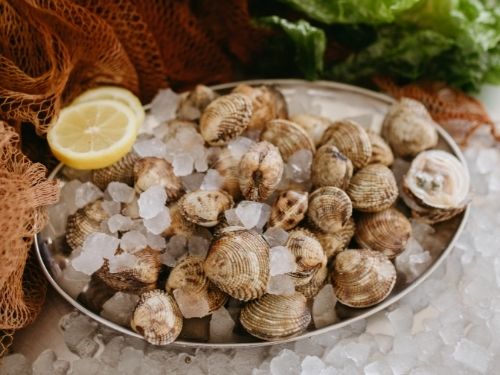
 The defining feature of Venerupis Decussata is the presence of two separate siphons. It has an equivalve shell, oval and inequilateral in shape, elongated along the transverse axis, with a truncated posterior margin. The shell is distinctly decussated: the external surface of the valves features a net-like pattern formed by prominent concentric growth lines that intersect with numerous radiating ribs. The pallial sinus is U-shaped, wide and rounded, but does not exceed half the length of the valve. A broad wedge-shaped space can be found between the lower margin of the sinus and the pallial line. Each valve contains three cardinal teeth. .
External and internal coloration of Venerupis Decussata
Externally, the shell typically displays pale gray or whitish tones, sometimes with contrasts of dark and light shades. Some specimens may appear whitish with yellow or greenish hues. They are often marked with lighter spots, irregular streaks and broken brown or black lines.
Internally, the coloration is whitish to yellowish, with bluish undertones. It may feature an elongated violet mark along the posterior margin of the hinge.
The history of Venerupis Decussata
 The harvesting of true clams primarily began in Spain and France. In Spain, as early as the 16th century, oysters were the most commonly consumed mollusks. Clam fishing emerged later and gradually expanded to Portugal. The first phase of intensive harvesting occurred during the late 1920s, specifically around 1926–1927: at that time, fishing was unregulated and all types of gear (even the illegal ones) were used to collect as many clams as possible. San Simón, in Spain, which was rich in clams, got rapidly poor once discovered by fishermen. Almost ten years later, in 1935, the first clam fishing regulations were introduced, mainly focusing on limiting the amount each fisherman could collect during low tide (about 14 kilograms). Increasingly strict regulations have been enacted over the years to protect this species, often considered at risk due to overfishing and intensive farming. Today, the main producers remain France, Spain, Portugal and other countries bordering the Mediterranean Basin.
Habitat of Venerupis Decussata
Venerupis Decussata shell thrives in sandy and muddy seabeds. It uses its siphons to filter water, capturing organic matter and feeding on phytoplankton. It can be found at shallow depths, usually just a few meters below the surface, and in sandy coastal areas. Reproduction is external and occurs in the summer months: the sexes are separate, although hermaphroditic individuals can occasionally be found.
Farming and processing of Venerupis Decussata
 Clam farmers collect seed clams from both natural populations and protected clam beds. The seed is gathered using a small spade, sieved and then distributed at densities of about 800 clams per square meter. Production can also be carried out using hatchery-based systems.
Farming techniques are fairly simple and include regular substrate maintenance, removal of algae and predators and routine care. Once harvested, if necessary, clams are sent to purification centers, such as Ittica Buonocore.
Fun facts about Venerupis Decussata
Few people know that Venerupis Decussata is the original “Vongola Verace” of the Mediterranean. Due to intensive fishing, it is now considered a vulnerable species in some regions. Its main competitor, Ruditapes Philippinarum, has different characteristics and is often farmed as a substitute. .
In terms of organoleptic properties, they stand out for the exceptional quality and freshness of their flesh, offering a delicate yet flavorful experience. Nutritionally, it is high in protein, low in fat and provides essential minerals such as phosphorus, iron and calcium. A 100-gram serving contains approximately 70 kcal.
Other Products




Where we are
83 Lufrano Street
Volla, NA 80040
our schedules
H24 distribution
Office 9 – 18


