
Ruditapes philippinarum
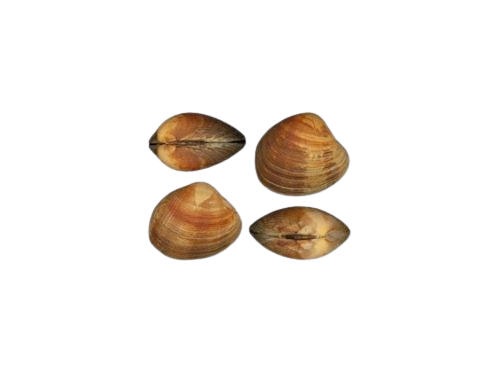
The Philippine hard clam, known as Ruditapes philippinarum, is a benthic bivalve belonging to the Veneridae family. Native to the Indo-Pacific region, it was introduced into several European countries between the 1970s and 1980s. Today, it is regarded as one of the most commercially important and widely consumed mollusk species in the world.
Morphological features of Ruditapes Philippinarum
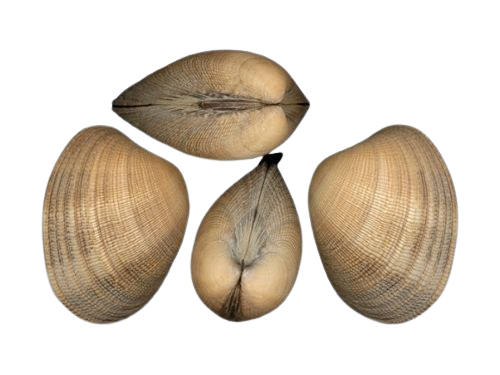
 As described by the FAO, Ruditapes philippinarum has a solid, equivalve shell, with inequilateral beaks located toward the anterior half. The overall shape is oval and transversely elongated. The outer surface of the valves features a distinct sculptured pattern formed by the intersection of radial ribs and concentric striae, which become especially prominent in the posterior region. In this area, the transverse grooves are well-defined and spaced, giving the surface a decussated appearance. Things you can notice:
- Three cardinal teeth in each valve;
- A central tooth in the left valve;
- Central and posterior teeth in the right valve;
No lateral teeth. The pallial sinus is broad but does not extend beyond half of the valve. It is smoothly rounded at the front and forms a wedge-shaped gap between its lower edge and the pallial line. The inner shell margin is smooth.
The differences with native species Tapes decussatus:
- Less elongated overall shape;
- More pronounced sculpture in the posterior area;
- Smoother shell surface in the anterior part;
- Siphons are fused at the base and separated only at the tips;
- Displays brighter and more varied coloration.
Ruditapes philippinarum external and internal coloration
Coloration and patterning are extremely variable. The external shell may range from whitish or yellowish tones to light brown or hazelnut, sometimes with isolated dark brown markings. The interior of the shell is typically white, often featuring orange or violet shades, especially near and around the pallial line and adjacent surfaces.
The Spread of Ruditapes philippinarum
 This species is native to the Sea of Japan, with a wide Indo-Pacific distribution. Wild populations are found in:
- the Philippines;
- the South and East China Seas;
- the Yellow Sea;
- the Sea of Japan;
- the Sea of Okhotsk;
- the Southern Kuril Islands.
It was later introduced to various parts of the world, where it has since established permanent populations. It arrived in the 1930s on the Pacific coast of North America, eventually spreading from California to British Columbia. In the early 20th century, it was also introduced into Hawaiian waters.
In European waters, the species was introduced in 1972 through French hatchery production. It spread across Europe, primarily to Italy, France, and Ireland, and has now become one of the most in-demand products. In Italy, the species was introduced in 1983 in the Venice Lagoon, specifically in the area of Chioggia, and later along the coasts of the Northern Adriatic, where it is now one of the region’s main aquaculture products.
Ecology and behaviour
Ruditapes philippinarum is a brackish water species that prefers sandy substrates in mid-tidal zones, at shallow depths (just a few meters). What does this species feed on? Primarily phytoplankton, which is why it thrives in eutrophic environments, those rich in nutrients. It is highly adaptable, even in the presence of physical and chemical changes, including anoxic conditions (low oxygen levels in the environment).
Reproduction
The breeding season can vary depending on the geographical area. Sexual maturity is reached at one year of age, when individuals are between 15 and 20 mm in size. The main reproductive period runs from May to October, with egg-laying occurring at temperatures between 20 and 25°C. This is followed by a period of sexual rest from late autumn to early winter, when waters are cold and especially low in phytoplankton. Gametogenesis, meaning the process leading to the formation of gametes (mature reproductive cells capable of fertilizing or being fertilized), lasts between two and five months and is followed by egg-laying. Larval development takes between two and four weeks, before the settlement phase, which is strongly influenced by two factors: wind and tidal currents.
How these clams are fished and farmed
 As previously mentioned, both production and harvesting can be carried out using different methods. Thanks to this species’ high adaptability (especially in our region) numerous farming centers have been established in controlled environments.
The production cycle begins with seed collection, which can involve gathering wild spat or using hatchery production. It’s important to note that during the selection process, great care must be taken: although clams have a strong protective shell, improper handling can easily cause them to break. Harvesting time:
- In China it ranges from 10 to 16 months, with clams reaching about 30 mm in size;
- In European waters it ranges from 16 to 30 months, with sizes between 30–40 mm.
Nutritional value and culinary uses of Ruditapes Philippinarum
With high protein content and low fat levels, Ruditapes philippinarum clams offer excellent nutritional value. Not to mention their Omega-3 content, which is essential for proper body function. They are also rich in phosphorus, iron, calcium, magnesium, zinc and selenium, and are an excellent source of vitamin B12. Thanks to their naturally sweet flavor and tender texture, Ruditapes philippinarum clams are well-suited for a wide variety of recipes and creative culinary preparations.
Other Products




Where we are
83 Lufrano Street
Volla, NA 80040
our schedules
H24 distribution
Office 9 – 18


