
MERCENARIA MERCENARIA

The Mercenaria mercenaria clam, also known as the Hard clam, is a common species with a unique and delightful flavor. Widely used in overseas cuisine for its firm and tasty meat. Let’s discover the story of one of the most popular species on the market.
The history of Mercenaria Mercenaria
Its discovery dates back to ancient times: around 1620, with the landing of the Pilgrim Fathers in what would later become Massachusetts. For this reason, it is also called the New England clam, featured in traditional seafood cuisine as the star of many dishes.
Why is it called “mercenaria” (mercenary)? The reason behind its name is that it was once used as a form of currency by Native Americans, who attributed a very high value to it.
Morphological characteristics of the American clam
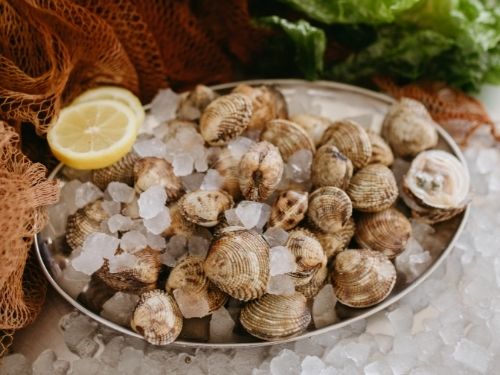
 It has a very strong and solid shell, broadly oval in shape. It is equivalve and inequilateral, with numerous fine concentric growth lines on the outer surface. Some of these lines are less visible in the central part of the valve. This happens because in younger specimens, the ridges cover the entire shell, whereas in the adult stage they remain only at the front and rear margins. Both valves feature a rough protrusion under the ligament. The pallial sinus is rather small and pointed. .
External and internal color
The shell’s color varies between:
- grey-brownish;
- grey-yellowish;
- light brownish.
The interior tends to be whitish, with violet shades of varying intensity near the adductor muscle.
The origins of the Mercenaria Mercenaria clam
This species has historical origins along the northeastern American coast, ranging from Nova Scotia to the Yucatán. It arrived in Europe in 1860.
To be more specific:
- In the Mediterranean: the species has been reported in the northern Adriatic and in some areas of the western basin;
- In the North Atlantic: it is found both on the western side (from Quebec to Florida and Texas) and on the eastern side (from the British Isles to northern Morocco);
- in the Eastern Pacific: mainly in the waters off California.
Habitat and nutritional values of the Mercenaria Mercenaria clam
 American clams prefer muddy seabeds with stones and shells, at depths of up to 10 meters. They love feeding on plankton and if food becomes scarce, they lay very few eggs or none at all. In short, no food means no reproduction! They can reach a maximum length of 12.8 cm.
The nutritional values for 100 grams of Mercenaria Mercenaria are as follows:
- Energy: 86.0 kcal
- Total fat: 0.96 g
- Saturated fatty acids: 0.187 g
- Carbohydrates: 3.57 g
- Sugars: 0.0 g
- Protein: 14.67 g
- Salt: 1502.5 mg
The secret of the Mercenaria clam: Quahog pearls
Although this species is abundant in both national and international waters, only 1 in 5.000 specimens manages to produce the magical Quahog pearl. Due to the mechanization and intensification of harvesting processes, it has become very difficult to find one today, making it a rare and highly coveted item.
Quahog pearls are considered among the rarest and most sought-after pearls in the world. However, their value depends entirely on how much someone is willing to pay: two examples of Quahog pearls have been sold for $14 and one million dollars, respectively.
Other Products




Where we are
83 Lufrano Street
Volla, NA 80040
our schedules
H24 distribution
Office 9 – 18


