
Pullet Carpet Shell

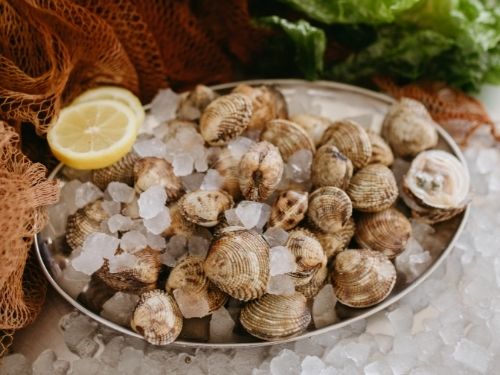
The Pullet Carpet Shell clam, commonly known as Longone clam, can grow up to 5 cm in length and is prized for its firm, delicious flesh. The history of Venerupis pullastrae has always been tied to intensive harvesting, especially in Spain. Back in 1956, clam production in Galicia accounted for 60% of Spain’s national output. Today this clam is primarily fished in Spain, Portugal and France.
Morphological characteristics of Pullet Carpet Shell
The Pullet Carpet Shell has an equivalve, inequilateral and solid shell, slightly oval and rounded in shape. It is transversely elongated and truncated at the posterior end.
On the outer surface of both valves, you can observe a fine reticulated pattern, formed by concentric growth lines intersected by delicate radial ribs, which are more pronounced at both ends.
The pallial sinus is large and deep but does not extend beyond the midline of the valve, leaving a wedge-shaped gap between the lower edge of the sinus and the pallial line.
External and internal coloration
The outer shell varies in color from whitish-grey, to light brownish tones and pale yellowish-white. Sometimes, you can spot dark patches or broken lines on the shell surface. The interior is yellowish-white, with purplish hues around the posterior margin of the hinge.
Habitat, farming and harvesting techniques
 These clams thrive in sandy and muddy seabeds, feeding on organic matter and phytoplankton, typically at depths of up to 40 meters. Their sexes are separate and hermaphroditic individuals can occasionally be found.
Reproduction takes place naturally or in hatcheries, mostly during summer. In spring, artificial stimulation is required, using higher temperatures and an abundance of food to encourage spawning. The larvae swim freely for 10–15 days before settling on the seabed.
How are Pullet Carpet Shell juveniles obtained? They come from protected beds, wild populations, or hatcheries. Once collected using a hand shovel, the juveniles are transferred to farming enclosures, where they are submerged (at a density of 800 clams per m²). Cultivation techniques are simple and straightforward: it’s important to keep the substrate clean, preventing algae growth and protecting the clams from predators such as starfish and crabs.
In Galicia, harvesting is still done in the traditional way: foot fishers walk the harvesting areas, using manual shovels or old-fashioned rakes to clear algae from the beds. After harvesting, if needed, the clams are sent to purification plants before reaching the market.
Other Products




Where we are
83 Lufrano Street
Volla, NA 80040
our schedules
H24 distribution
Office 9 – 18


