
BROWN MUSSEL
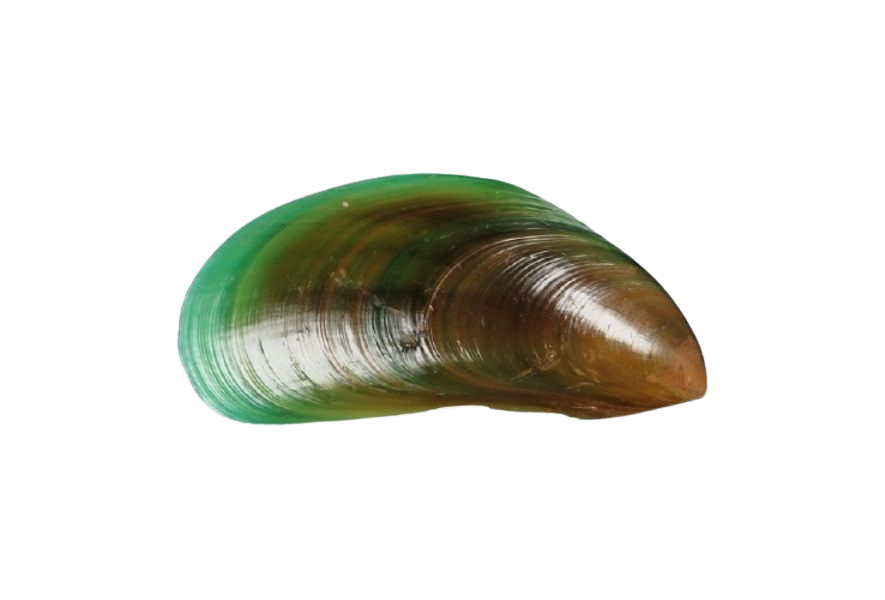
In this article we’ll explore one of the most appreciated types of mollusks: the brown mussel. Reaching a maximum length of 16.5 cm, it comes from the Indo-Pacific and has a very unique history. Let’s discover it together.
Morphological characteristics of the Brown Mussel
 The shell is equivalve, inequilateral, elongated, and roughly triangular in shape. It is pointed at the front and rounded and compressed on the back, tapering into a sharply pointed beak that curves downward.
The upper edge is curved, while the lower edge is long and rather concave. The posterior edge is rounded, and the anterior edge is reduced.
As for the valves:
- The outer surface is covered by a thick, glossy periostracum with concentric growth lines;
- The right valve features one interlocking tooth;
- The left valve has two interlocking teeth.
As for the muscles:
- There is no trace of the anterior adductor muscle in adult specimens;
- The posterior adductor muscle scar merges with the retractor muscle scar (which is very large);
- The anterior retractor muscle scar is oval-shaped and separate from the others.
The coloration of this mussel is quite distinctive: young specimens are bright green, darkening (to brownish) as they age. The interior is pearly with a bright green edge.
The story of Brown Mussel’s diffusion

Perna Viridis mussels originate from the Indo-Pacific, the Persian Gulf and the Gulf of Thailand. Only later they were introduced into multiple regions, including:
- China and southern Japan
- Polynesia and the Caribbean
- Eastern United States
- Western Atlantic
Sporadic occurrences have also been recorded in northern and western Australia and in South Africa.
The brown mussel is considered a truly invasive species. Since its introduction outside of its native waters, it has shown an extraordinary ability to form dense colonies, reproduce rapidly and thrive in a wide range of environmental conditions.
It is worth noting that it can form dense populations of up to 35,000 individuals per square meter.
Habitat and biology of the Brown Mussel (Perna Viridis)
Let’s now take a look at this species’ reproduction. The most important facts to know:
- The reproductive peak occurs once a year, but the breeding season is very long (they may spawn every month of the year);
- Fertilized eggs develop into free-swimming larvae that float for two to three weeks. After that, they settle on a hard surface. After two to three months, they become sexually mature;
- Their lifespan is about 4 years;
- They are highly sensitive to cold air: exposure to temperatures of 0–2⁰C for several hours leads to high mortality rates.




Where we are
83 Lufrano Street
Volla, NA 80040
our schedules
H24 distribution
Office 9 – 18


