
MEDITERRANEAN MUSSEL

Mediterranean mussels are without a doubt the most well-known, appreciated and internationally purchased species. With incredible health benefits, old origins and undeniable “superpowers” (which we’ll soon explore), here’s an in-depth look you’ll want to savor down to the very last bite!
Morphological characteristics of Mediterranean mussels
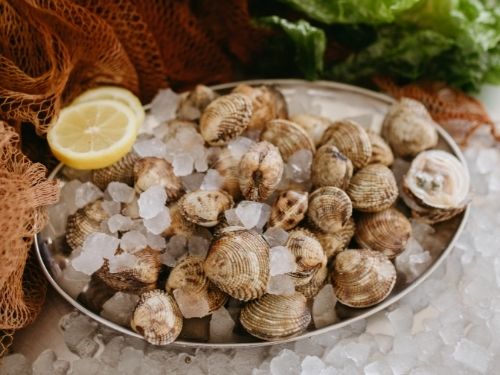
 Mediterranean mussels, classified as Mytilus galloprovincialis, are bivalve mollusks known for their elongated, black shells. The edible part, featured in countless dishes and recipes, is made up of the internal organs, enclosed in a soft mantle whose color may vary (yellow, orange, white and, in some cases, even red).
The shell is equivalve but inequilateral, with a subquadrangular shape. It is elongated and slightly wider in the central area. The upper margin is long and curved, while the lower margin is straight. The posterior edge is rounded, like the upper margin, while the anterior edge has a lunule shape.
As for the valves:
- The posterodorsal area shows a strong, flattened expansion, making the ligament edge protrude;
- The inner surface displays the imprint of the posterior adductor muscle, which merges with the posterior retractor muscle and the anterior adductor muscle (smaller but clearly visible);
- The ventral surface is flattened behind the umbo;
- The outer surface is covered by a thin, glossy periostracum, with noticeable concentric growth lines;
- They are joined by a lamelliform hinge, a sort of natural filter the mussel uses to retain nutrients. However, this can also trap harmful pathogens and that’s why it’s essential to purchase mussels from certified depuration centers that guarantee freshness, flavor and safety, free from any toxic element.
The hinge that connects the two valves may have three or four small teeth.
The shell, as we mentioned before, is usually black or has a purplish hue, and shows growth rings. The interior is smooth, with a pearly white color and the classic teardrop shape.
The history of Mytilus Galloprovincialis
We all know that China is currently the world’s leading producer of Mytilus galloprovincialis. What’s less known, however, is that the first evidence of mussel consumption dates all the way back to the 4th century BC, in the Galician region, thanks to ancient shell deposits that contained mussels, among the others.
According to the FAO, these deposits were known as “concheiros” and were later also found in Roman cities (back to the 1st century BC).
From there, we fast forward to the 16th century, when Portuguese settlers began harvesting mussels in the Cambados area. The first mussel farming attempts in Spain took place in Tarragona and Barcelona in 1901 and 1909, using structures (the well-known wooden poles) similar to those in France. This method was abandoned after some attempts, and was replaced by the floating system one.
In 1946 raft farming was introduced and mussel production doubled in just a few months! These rafts were made from wooden frames, supported by a central float and sometimes even repurposed old ships. Ropes were suspended from the structure, to which mussel seeds were attached by farmers. Once the mussels reached maturity, they were harvested by hand.
Distribution of the Mediterranean mussel
As its name suggests, the Mediterranean mussel is primarily found in the Mediterranean Sea and the eastern Atlantic Ocean. From Ireland and the UK to North Africa, its reach has expanded even further—today it can also be found along the North Pacific coasts of North America, in Japan, Chile, and Australia. Its presence in these non-native regions is undoubtedly the result of human aquaculture activities.
Biology, habitat and ecology
 To understand the ideal habitat of the Mediterranean mussel, we can look to Galicia as a model, marked by river valleys that provide the perfect environment for mussel farming. These valleys, commonly known as “rias”, can be up to 25 km long, between 2 and 25 km wide, and reach depths of 40 to 60 meters. These rias replicate the environment, climate and ideal temperatures for mussels and their development, enriched with all the essential nutrients (including phytoplankton).
Among the most well-known rias is the de Arousa, which accounts for 60% of Spain’s mussel production, followed by the Ría de Vigo and the Ría de Pontevedra
Thanks to these optimal conditions, mussels in Galicia can reproduce year-round. Each mussel produces millions of eggs, which develop into larvae, carried by tides and currents until they settle on rocky surfaces, first temporarily, then permanently.
Production and farming systems of Mytilus galloprovincialis
The farming of Mytilus galloprovincialis is always extensive, regardless of location. But how does this process works? Let’s take a closer look!
It all begins with seed collection, which farmers typically gather from natural mussel beds. The seeds can be grown using various techniques, with the raft culture system remaining the most widely used, just as it happened in the past.
The seed is manually or mechanically attached to ropes. The third stage (following seed collection and attachment) is thinning, an essential process that:
- Guarantees a healthy and even growth;
- Prevents mussels from detaching in adverse weather conditions;
This procedure is usually done when mussels are about 5–6 months into the growth cycle, mostly during summer.
The fourth stage is the actual cultivation. In places like Galicia, where mussels grow quickly, they can reach commercial size in as little as 8–9 months. However, growth may be delayed due to overcrowding of rafts in a given area.
You want to learn something more about mussels?
 1. Each raft typically uses three ropes: one for seed collection, one for growing mussels collection and one for the final harvesting.
2. A medium-sized wooden raft lasts between 10 and 15 years. Modern versions are even more durable.
3. Average production per raft is 130 kg/m², with total output averaging around 47 tons.
The final step involves handling and processing. Once harvested, mussels are packed in nylon sacks and transported by boat directly to depuration centers. Mechanization in this stage is kept to a minimum in order to:
- Avoid damaging the mussel shells;
- Extend shelf life;
- Protect the health of the mussels.
The superpower of Mediterranean mussels: let’s find it out
Only a few realize that Mediterranean mussels possess a genuine superpower: resilience. Thanks to their properties, unique structure and biological traits, these bivalves are remarkably resistant to climate change. Specific genetic variants allow them to adapt, survive and even fight back against ocean acidification caused by rising CO₂ emissions.
How was this ability discovered? Thanks to an international study published in Nature Communications. The subjects of this analysis were several mussel samples selected for their physical, genetic and morphological traits. These samples were split into two groups:
- On one side they were was placed in normal seawater pH, which is typical of marine waters;
- The other side was kept in more acidic waters, with a pH of 7.4 (similar to what is expected in the next 100 years due to climate change).
The results? Mytilus galloprovincialis was able to withstand the more acidic conditions. While growth initially slowed, within two weeks the mussels resumed growing and eventually reached normal size.
So where does their power lie? In their DNA. Their genetic structure enables them to adapt to new environments and continue developing.




Where we are
83 Lufrano Street
Volla, NA 80040
our schedules
H24 distribution
Office 9 – 18


