
THE SHELL OF SAINT JAMES

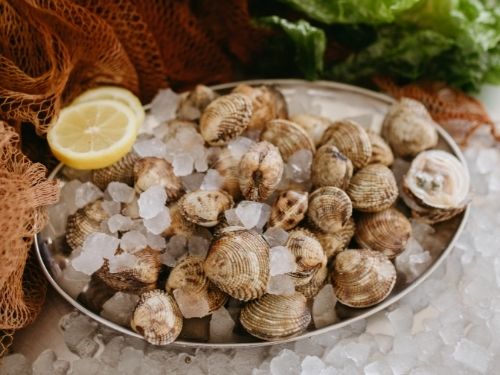
When we talk about Pecten Jacobaeus we’re referring to the scallop commonly known as the Shell of “Saint James”. This bivalve mollusk belongs to the Pectinidae family, along with its close “relative”, the small scallops.
Its shell is equilateral and subcircular in shape, and it is characterized by:
- a distinctive fan-shaped opening;
- two valves of unequal size. The lower right valve is convex, while the upper left valve is relatively flat;
- On each valve it has at least 14 radial ribs (sometimes up to 18). These ribs radiate outward from the hinge. They are separated by intercostal spaces, and the surface itself is further marked by 3 to 4 smaller secondary ribs.
The main feature of this mollusk is its catadioptric eyes, an extremely rare trait in the animal kingdom. How do they work? Through reflection.
Thanks to jet propulsion, scallops can move quickly by forcing water out of their shells (thanks to the rapid opening and closing of the valves). An efficient defense mechanism to escape predators.
Scallops can reach a maximum size of 14 cm and live up to 18 years. They prefer sandy seabeds and are widely found throughout the Mediterranean Sea, with additional populations in the North Sea and eastern Atlantic Ocean, in this area, though, they are often replaced by their larger cousin, the “Pecten Maximus”.
Scallops are harvested both commercially with fishing gear and by hand (especially in the North Sea). You can also find farmed scallops (their taste is basically the same of their wild counterparts).
Where Does the Name “Saint James” Come From?
The name is tied to the pilgrimage of Santiago de Compostela, one of the most important Christian pilgrimages alongside Jerusalem and Rome. Even today, thousands of pilgrims reach this place on their way to the tomb of Jesus’ apostle.
An old legend tells that, at the very moment a boat was transporting the lifeless body of the Apostle James (near the Cíes Islands), a wedding ceremony was taking place nearby. As tradition dictated, the groom was to participate in a local ritual game. The challenge consisted of riding a horse, tossing a spear into the air, and catching it before it touched the ground.
As the groom threw the spear, instead of falling to the ground, it veered toward the sea. The groom and his horse dove into the water after it, only to be swept away by a strong wave. Just as onlookers feared the worst, the groom and his horse miraculously reappeared beside the boat of the Apostle of St. James. The peculiarity is that the groom was covered in scallop shells. Convinced he had witnessed a miracle, the groom converted to Christianity. After sharing his story, the others followed and converted as well.
Another account appears in an illuminated manuscript attributed to Pope Callixtus II, which speaks of the scallop shell as a tribute pilgrims would offer to the Apostle. From ancient times (when shells were seen as lucky charms and used as makeshift cups to drink from rivers) to today (when the shell symbolizes protection and wisdom and is thrown into the ocean in Finisterre) the scallop shell has carried deep meaning, beyond its unmatched culinary value.




Where we are
83 Lufrano Street
Volla, NA 80040
our schedules
H24 distribution
Office 9 – 18


