

Fishing is one of humanity’s oldest and most fascinating stories.
Since prehistoric times, humans have relied on fishing both as a way to obtain food and as a recreational activity.
Over the centuries, fishing techniques have evolved significantly with the introduction of new tools and methods.
This article will show you how fishing has become a global activity, while also exploring the impact it has had — and still has — on culture, ecosystems, and trade.
History of Fishing
All around the world, fishing is a central part of many communities economies and cultures, and it still is a source of livelihood for many people.
Unfortunately, water pollution and the intensification of fishing practices have led to declining fish populations and the extinction of certain species. However, the history of fishing is filled with remarkable events and innovations that can be discovered by examining this practice through different periods of time.
And that’s exactly what we’re about to do: from the Paleolithic era to the present day, we’ll explore how humanity’s relationship with fishing has truly evolved and what impact it has had on the climate.
Fishing in the Paleolithic Era

Fishing originated during the Paleolithic era, when humans began hunting and gathering food from water.
Archaeological evidence suggests that early fishers used rudimentary rods, nets and traps to catch food, while more advanced techniques involved the use of slings or spears made from sharpened bone tips.
During the Paleolithic period, fishing played a crucial role in supporting communities and providing nutritious food, and it was carried out by both men and women. Men used basic weapons, while women stayed along the shore, mainly collecting mollusks with their bare hands.
This organization worked well for that time but, in the Neolithic era, there was a need to create new and improved tools to guarantee more efficient fishing.
The first nets of that time were made from twigs, leaves, and roots placed in narrow, shallow areas of water to block the fish’s escape route, making them easier to catch.
But no one could have imagined that this was just the beginning.
Fishing in Ancient Egypt

In the Nile Valley fish was one of the main sources of nourishment. There were various fishing methods, but the most common technique involved lines and hooks. During the New Kingdom, people started using fishing rods. The most effective method, however, involved two boats dragging large nets: one end of the net floated on the surface thanks to attached floats, while the other end was weighted down with a ballast, allowing it to sweep along the bottom.
During the Classical Period, fish was a crucial food resource for Greeks and Romans. Smoked or preserved in salt, the most common fish provided a primary source of nutrition for the general population. Fish was far more affordable and accessible than meat, which was a luxury reserved for just a few.
The fishing tools of the time were mostly made of copper: hooks were tied to lines made from animal hair or plant fibers, with lead weights to sink them deeper. Other tools were various types of nets, spears and tridents, woven wicker fish traps and oil lamps for night fishing.
Post-Roman Fishing
After the fall of the Roman Empire, fishing continued to be a vital activity for many people.
The advent of ocean navigation allowed fishers to reach new territories and further expand their knowledge of the marine world.
This period saw the development of the first sailing fishing boats and the invention of early preservation techniques such as salting and smoking.
Fishing in the Middle Ages
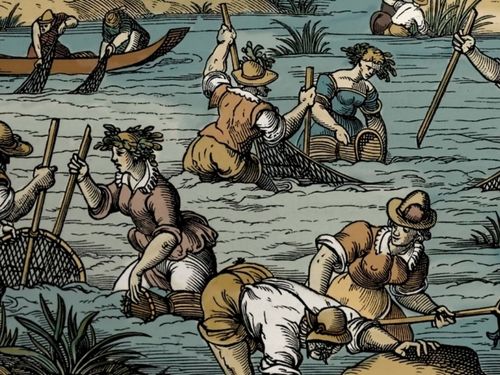
During the Middle Ages, fishing gained economic importance as a form of subsistence for many people across Europe.
The main techniques involved fixed nets and longlines deployed from cargo ships. The nets were made from natural fibers like hemp or linen and were put into water from the boats. There were longlines too: small boats equipped with harpoons used to catch larger fish.
The frontiers of 20th Century fishing
With the advent of the industrial era in the 1800s, fishing techniques underwent rapid development thanks to technological innovations and the use of more durable materials such as fiberglass and plastic.
In the 20th century, fishing boats became larger and more powerful, and nets grew in size to reach greater depths than ever before.
Moreover, thanks to the introduction of satellite navigation, it’s now possible to accurately locate the best fishing areas: by concentrating the efforts in these areas better fishing results are guaranteed.
The evolution of fishing techniques
In recent decades, fishing technology has become increasingly advanced: high-definition sonar, underwater robots, and exoskeletons now allow modern fishers to achieve unprecedented levels of efficiency and productivity.
Marine engines and artificial lures are also becoming more sophisticated, enabling fishers to catch increasingly large fish with relative ease.
Despite the millennia since its origins, fishing continues to evolve and offer new opportunities to humanity: yet another testament to our remarkable resilience and adaptability in the face of a changing world.
Let’s see, below, an in-depth look at some of today’s most commonly used fishing techniques.
Trawling

Trawling is a fishing method that involves dragging a net behind a moving boat across the surface of the water. It is commonly used to catch marine species such as tuna, mackerel, herring, swordfish, and other types of fish.
The effectiveness of trawling depends on the position of the nets in the water, the speed of the boat, and even the height of the nets relative to the surface.
Once the trawling session is complete, the synthetic or biodegradable net is hauled back in, along with the catch gathered during the operation.
However, trawl nets can have a harmful impact on marine ecosystems due to their tendency to catch non-target species (such as sea turtles) and to destroy seabeds by dragging along algae, corals, and everything else in their path.
Aquaculture

According to history, it is likely that humans learned to “cultivate water” even before they started cultivating the land.
Aquaculture is a practice that consists in farming aquatic animals in specially designed tanks or water channels. It can be conducted both in open environments and in enclosed water systems. This method provides a sustainable way to produce fish, mollusks and crustaceans, and it is widely used around the globe.
It offers a safe and affordable source of food for local populations and can also serve as an educational and ecological initiative.
Compared to land-based livestock farming, aquaculture is characterized by:
- a low carbon footprint
- a low feed conversion ratio (FCR)
- high protein and energy retention
- very high yields
The potential of the aquaculture sector is vast, and future projections suggest a further increase in its adoption, with growing environmental awareness and sustainability at its core.
Mariculture

Mariculture is a form of aquaculture that focuses on the intensive farming of marine species in artificial ponds or lagoons.
This method is widespread globally and is often used as an alternative to wild-capture fishing, ensuring a steady and reliable seafood supply. The ponds are typically surrounded by nets that prevent wild animals from entering and disrupting the farmed environment.
This is considered one of the more sustainable techniques, as it involves raising marine species in their natural habitat, helping to preserve local marine flora and fauna.
Mollusc Farming
Mollusc farming involves the intensive cultivation of clams and other mollusks in specially designed tanks or cages.
This method is widely used due to its positive environmental impact: mollusks themselves play a key ecological role as natural water purifiers.
Another significant aspect is the that there’s no need of feeding, since these marine organisms feed by filtering phytoplankton from the water.
Environmental impact of fishing methods

As we have seen, many of the main fishing methods can have a positive environmental impact on surrounding marine ecosystems.
Surely though, the most harmful of practices is trawling, as it can cause ocean pollution due to the organic waste discharged from fishing ships. It can also cause irreversible damage to natural habitats due to the accidental catch of non-target marine species and the destruction of the seabeds.
On the bright side, one of the most positive fishing methods is mariculture, mollusc farming and aquaculture are considered highly beneficial and full of potential:
- Aquaculture can produce large volumes of high-quality, healthy, and traceable seafood.
- Mariculture protects natural habitats through on-site farming that prevents disruption to local ecosystems.
- Mollusc farming contributes to cleaner marine environments through the concentrated cultivation of filter-feeding mollusks that naturally purify the water.
To reduce the environmental impact of fishing, it is essential to encourage responsible practices that aim to preserve natural marine habitats and minimize the catch of non-target species.
Additionally, it should be promoted the use of advanced technologies to mitigate the negative effects of fishing techniques and to improve the use of eco-friendly or biodegradable materials.
The SMARTFISH Project
This project is funded by the European Union and is born from the urgent need to reduce the fishing industry’s negative impact on marine life.
On the project’s official website you can find full details about the developed innovative smart technology.
Specifically, we quote:
“The technologies being developed to support sustainable fishing include an indoor pool able to simulate the ocean environment, laser scanners for fish stock analysis, and 3D visualization methods to create seafloor models. One of the technologies that are currently developed is CatchScanner, which combines laser technology, a 3D camera system, and artificial intelligence for data analysis. When a fish is placed inside the scanner this generates both a 3D and a color image, used by IA to estimate the weight and species of the fish”.
Another innovation developed within the SMARTFISH project is a trawl net called SmartGear, designed to attract only targeted fish species while allowing non-target species to swim away freely. To do that, the net uses LED lights of various colors to capture the attention of desired species, taking advantage of their natural response to light stimuli.
The ultimate goal of the SMARTFISH project is to equip fishing ships across Europe with these technologies. The SMARTFISH systems will be tested in various maritime regions: the Norwegian Sea, the Mediterranean and Black Seas, the western coast of Scotland and the northern North Sea, the southern North Sea, the Celtic Sea and the Bay of Biscay, as well as the Kattegat and Skagerrak straits.
In conclusion, fishing is a recreational and sporting activity we’ve been fortunate to enjoy for generations.
However, it’s important to remember that each fishing technique has a different environmental impact. This is why it’s essential to be aware of the possible negative effects of our actions and to adopt the best measures to minimize them: for that, we have to thank innovative projects like SMARTFISH.
By choosing more sustainable fishing methods and respecting the regulations and limits in place, we can guarantee that our fishing activities have a positive impact on the environment. Even consumers can play a key role by making more informed choices when buying seafood, decisions that support a more sustainable fishing industry.

